In Your Nature
Native Iowan?

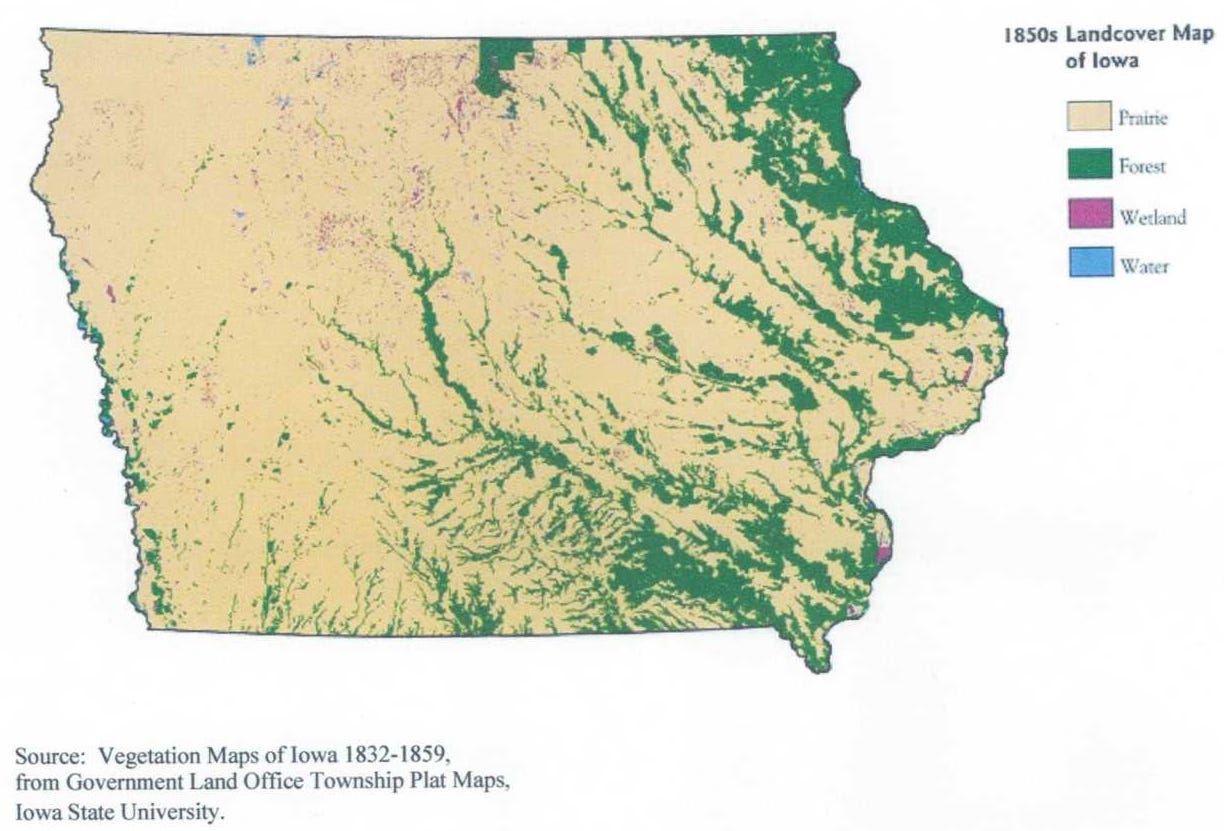
Source: Here
It’s true that I was born and raised in Iowa. It’s also true that I have lived approximately 86% of my life in Iowa. The other 14% was asymmetrically divided between Wisconsin and Colorado. So, I guess I could claim to be a “native Iowan”. But am I really? The indigenous peoples of Iowa might not accept that claim.
What does it mean to be a “native species”? From a biological perspective a species is “native” in the location in which it evolved and in any additional locations it was able to expand its range to, without assistance from humans. For example, big bluestem grass (Andropogon gerardi) is native to Iowa and covered vast areas of the state before European settlement. Large areas of Iowa that once grew big bluestem (and many other prairie plant species) now grow soybeans (Glycine max), which are native to eastern Asia. The wild ancestor (Glycine soja), from which soybeans were domesticated, can still be found today in China, Japan, and Korea. Soybeans are not native to Iowa and are an example of an “introduced” species due to assistance from humans.
Before humans were able to, relatively easily, travel long distances, other species tended to stay put, more or less, in their “native range”. Lions were doing very well in parts of Africa, but they had no way to get to North America. North American bison were astonishingly numerous, but they were unable to swim the Bering Strait to get to Siberia. Depending on climatic changes, species could certainly expand (or contract) their native ranges. For example, 18,000 years ago when the last ice age was at its maximum, most of north central Iowa was covered by glacial ice and the prevailing weather patterns were quite different from today. Big bluestem grass would have been very rare or absent from the state. After the climate warmed and the glaciers receded, big bluestem expanded its range into virtually all of Iowa. Truly long-distance movement, however, was (and is) very rare. A remarkable example of long-distance range expansion occurred in about 1877 when African cattle egrets were observed to be present in Guiana and Suriname in South America. They appear to have flown across the Atlantic Ocean, a very impressive example of long-distance range expansion! African cattle egrets have done very well in the Western Hemisphere and can now be found as far north as Canada. Whether African cattle egrets should be considered “native” to North America is a “gray area”, but they did expand their range to North America without assistance from humans.
Once humans could, relatively easily, travel long distances we got right down to the business of transporting other species with us around the world. Such species are called “introduced” species, and can be divided into two major groups: species that were “intentionally introduced” and species that were “accidentaly introduced”. Intentionally introduced species tend to be species with economic impact. Livestock such as the horses introduced to the Western Hemisphere by the Spanish “Conquistadors”, or turkeys brought back to Europe by those same people. Crop plants like soybeans from Asia, or tomatoes and potatoes that crossed the Atlantic Ocean from west to east on wooden sailing ships. Accidentally introduced species tend be smaller and, if they have “economic impact” it tends to be negative. The “Norway rat” (also called the brown rat) is an excellent example. They were accidentally introduced into North America from Europe, via rat infested ships, between 1750 and 1775. Norway rats appear to have actually originated in northern China, so they had probably been introduced (likely accidentally) into Europe, perhaps as early as the 1550s. Rats, of course, cause a range of miseries for humans ranging from destruction of stored food to vectoring of various diseases. Norway rats also cause problems for other species by competing with, and feeding on, local native species. In any case, their introduction has not been a “happy accident” anywhere in the world.
Once a species has been introduced by humans into a region that is not part of its native range three things can happen. First, the species can fail to thrive and not become established in the new location. Second, the species can become established in the new location without causing obvious problems for local native biodiversity. This outcome is referred to as the species becoming “naturalized”. Ring-necked pheasants and brown trout would be good examples here in Iowa. Third, the species can become established, do extremely well in the new location, and have substantial negative impacts on local native biodiversity. Such species are said to be “invasive”. Some invasive species have been intentionally introduced. A good example in Iowa would be multiflora rose. This plant was intentionally introduced to serve as a “living fence” and currently outcompetes many native forest understory plants while making some Iowa woodlands virtually impenetrable by humans. Other invasive species have been accidentally introduced. A recent example that is causing havoc in Iowa is the emerald ash borer, which is causing the death of ash trees all over the state. Additional invasive species with significant impact in North America include the fungus that causes “Dutch elm disease” kudzu, purple loosestrife, zebra mussels, common starlings, Asian carp, and Burmese pythons.
Where are humans native? That proves to be a difficult question to answer. The best available evidence tells us that modern humans evolved in Africa between 200,000 and 300,000 years ago. Strictly speaking then, one might argue that “humans are native to Africa”. Migrations over many generations allowed humans to expand their range first to Asia and Europe, then to Australia, and most recently to North and South America. Exactly when humans arrived in North America from Siberia is a matter of current scientific research, but an approximate estimate would be 20,000 years ago or less. In other words, humans have been present in the Americas for about 10% of our species’ entire history. Given the presence of the ice age land bridge between Siberia and North America, and the width of the Atlantic Ocean, it’s not surprising that humans from Europe did not arrive in North America until much more recently. Viking settlers had a brief presence in North America about 1,000 years ago, while the arrival of Europeans in large numbers began in 1492 with the explorations of Christopher Columbus.
Given the origin of our species in Africa, are humans “native” or “introduced” in North America? One might argue that humans were not intentionally, or accidentally, introduced to North America by some other species, so this is just an example of “range expansion” and we’re just as native in North America as we are in Africa. The same argument could be made for African cattle egrets. We were, however, aided by other species in this expansion: the tree species used to build ships, the animal and plant species consumed to keep the migrants alive on their arduous journeys. Is the number of generations in a location important in deciding whether a species is native? Does the 1,000 or so generations of North America’s indigenous peoples make them more “native” than someone like myself whose genetic information has only been present in North America for three or four generations? I’m not sure there are any “easy” or “correct” answers to these questions. Perhaps the best answer is that humans are “native” to Planet Earth. Maybe we should start caring more about our home and less about short-term profit. Maybe protecting the amazing biodiversity we share our home with should be a much higher priority than is currently the case. Maybe we should be very careful that changes we cause to our home don’t make Earth unlivable for us.
If you’ve read this piece, or any other of my pieces, you’re probably asking some version of this question: “How did Jim get to be so weird?”. Now for the low, low price of $15.95 (plus tax and shipping), you can answer that compelling question. Click here. Proceeds (should any ever occur) donated to local environmental groups.
Wonderfully written diagnostic overview of the world condition. The proper perspective that we all should strive towards when drawing conclusions about where we are, how we got here, and where we’re headed.
Utterly revealing, and completely disgusting, that so little was saved for future generations. Now, we’re faced with an administration determined to undermine protections for the shrinking public lands which still remain. Truly, a “my God what are we doing” moment in our nation’s history.