In Your Nature
Simple Answers

Bring it on home… Bring it on home to you – “Bring it on Home” (as performed by Led Zeppelin)
A student came up to my desk after an introductory biology class and gave me an incredulous look. “You mean scientists KNOW that lichens are composed of two distinct species, but the scientific name of the lichen is just the name of ONE of those two species? I thought a scientific name was supposed to specifically refer to a single type of organism. Why are scientists lying to us about this?” I tried, with little effect, to explain that each lichen has a distinct species of fungus, while many distinct lichens can have the same photosynthetic partner. I even left out the part that many (most?) lichens are, at least, a three-way symbiosis that includes one (or more) specific yeast species. Some lichens may even be a foursome composed of the fungus that gives the lichen its name, a green alga, a yeast, AND a cyanobacterium. Not surprisingly, additional bacterial species are also found as parts of lichens and it’s become clear that lichens are not “dual organisms” as typically described in introductory biology textbooks, but rather a “multi-species symbiotic relationship”. Effectively, a lichen is an “ecosystem” not an “individual”. My student had been seduced by the desire for a simple answer and would doubtless have been even more distraught had I shared the whole story. People do greatly prefer simple answers.
Let’s take a moment to bring this “on home” to us. Look in a mirror. How many species do you see? One, of course. Could the questions get any easier? I mean there you are: Homo sapiens in all your evolutionary glory. One species, one name. Simple. But, like virtually everything in biology, it’s not. Your human body includes about 50% human cells and about 50% NON-HUMAN cells. We’re all just “half-human”. To be fair, these non-human cells are very small, so most of your body weight is due to human cells. These non-human cells include bacteria, archaea (a distinct type of prokaryotic cell), fungi, and protists, and are collectively referred to as the “human microbiome”. There is not just one species of each type either. The human gut is estimated to include 500 to 1,000 distinct species of bacteria. Another few hundred are found on our skin. More are found in other parts of our bodies. A name telling the “whole story” about what a human is would lead to a VERY LONG “scientific name”. Micro-animals can also live on human bodies though they are not considered to be part of our “microbiome”. Eyelash mites are an excellent example of a micro-animal species that could be “staring back at you” from the mirror.
Some species in our microbiome are “mutualistic”, that is both they and we benefit from our close association. Very similar to the relationship between a lichen fungus and its photosynthetic partner. Other species seem to share our bodies with little impact on us. Some species in our microbiome can cause diseases of various types under the right circumstances. Just like lichens, we give a scientific “species name” to humans, but our bodies are NOT just one species. In effect, each of us is an “ecosystem” composed of many different species, playing various roles, most of which we don’t fully (or at all) understand. In a sense “Homo sapiens” is the name we give to a particular type of ecosystem not so different from the name we give to an ecosystem like a “coral reef” or a “tallgrass prairie”. Viewed from this perspective, lichens are unusual not because each “individual” includes more than one species, they are unusual because they are a relatively simple example of this phenomenon.
It’s not just lichens and humans that are ecosystems rather than individuals. Every animal you’ve ever seen also has a diverse microbiome. Dogs. Cats. Crows. Earthworms. Blue whales (if you’ve been fortunate enough to see one). We think of each these as “a species” and we give them each a scientific name: Dog; Canis familaris, etc. And yet each of these is an ecosystem composed of many individuals, of many distinct species, not just one individual. And, by the way, the microbiome of dogs is distinct from that of cats, and crows, and earthworms, and blue whales… and it doesn’t end there. Plants also have a microbiome. The white oak tree (Quercus alba) you walked past in the park includes individuals of many species both inside the body the tree and associated with it externally, similar to the bacteria living on our skin. Other plant species have distinct microbiomes. What we think of as an individual member of a species is better thought of as a little ecosystem living inside a world of larger ecosystems, like Matryoshka dolls.
As a last attempt at seeking some simplicity in a complicated world, you might be inclined to think that, while the human microbiome is distinct from a dog (or any other animal) microbiome, microbiomes amongst all individual humans should, at least, all be the same. You would be incorrect. The microbiomes of individual humans are demonstrably distinct from each other. This is part of the reason that fecal transplants can be effective at treating various illnesses. When does this “complexity shit” ever stop?!!
The answer is probably “never”. The biological world, and the rest of the world (not to mention the Universe), is complex. There are some questions with simple answers: “Should I jump off that tall cliff expecting to fly?” No. Unless you’re a bird or you’re wearing one of those wingsuits. Important question, with a (mostly) simple answer. Many questions, however, do not have simple answers. How many species are currently present on Planet Earth? Seems like a simple question. We’ve been working this for hundreds of years, surely, we know the answer by now! We don’t - and it’s not for lack of effort. It’s a complex question due to the incredible diversity of biological organisms and also because it depends on precisely how one defines “species”.
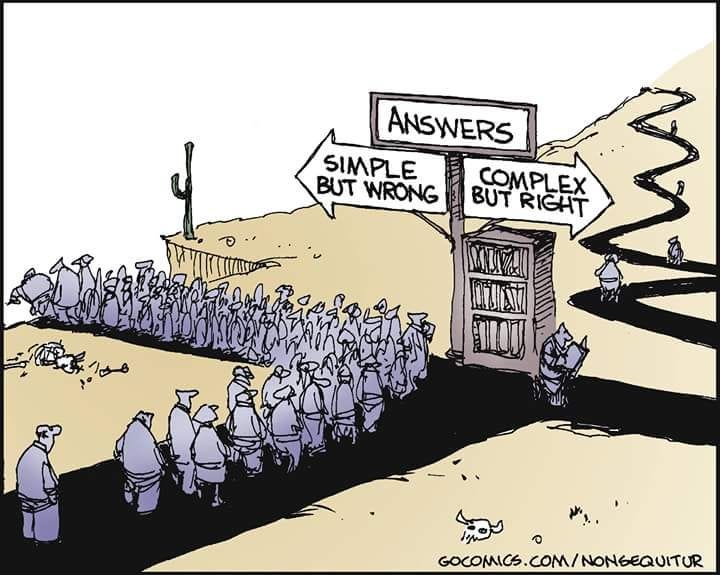
Simple answers are seductive. “My country, right or wrong.” “There are only two genders: male and female.” “My religion is absolutely right.” “Humans have dominion over the Earth.” “Profit is more important than any other concerns.” Simple answers take away the burden of having to think, having to evaluate relevant evidence, having to consider the possibility that your current conclusion may be incorrect. I recommend being skeptical of those who espouse simple answers. Such claims are often incorrect and not uncommonly self-serving. Coming to fully understand a complex answer often requires a great deal of effort. I spent an entire career coming to understand biology – and there’s still much I don’t know or understand. Being humble about what one understands makes possible unbiased consideration of evidence that contradicts one’s current understanding. Potentially leading to the dreaded (by some – not me) “changing your mind”. Realizing the complexity of, and embracing the world as it is, can lead to thinking things like: “My country – and if it’s not right, I’m going to help make it better.”
If you’ve read this piece, or any other of my pieces, you’re probably asking some version of this question: “How did Jim get to be so weird?”. Now for the low, low price of $15.95 (plus tax and shipping), you can answer that compelling question. Click here. Proceeds (should any ever occur) donated to local environmental groups.
Jim’s piece does something very interesting: it takes a familiar bit of biology and uses it to gently pry open our assumptions about what an “individual” is. Lichens become a doorway into a much larger truth; that life is built from relationships, not neat categories.
What struck me most is how liberating this perspective can be. Learning that a lichen is a community rather than a single organism doesn’t undermine science; it expands our sense of what life can be and the same is true when we turn that lens on ourselves. Discovering that each of us is an ecosystem; half-human by cell count, wholly dependent on countless microbial partners, doesn’t diminish our humanity, it deepens it and reminds us that cooperation and interdependence aren’t exceptions, they’re the pattern. There’s something hopeful in that.
Complexity isn’t a trap; it’s an invitation. It asks us to stay curious, to revise our stories, to resist the comfort of slogans and simple answers and it gives us a better way to think about change. If lichens can reorganize their partnerships, and microbiomes can shift and adapt, then perhaps our own thinking can be just as flexible.
In a world that often rewards certainty, pieces like this remind us that wonder lives in the details, and that humility is a strength. The more we learn, the more interesting everything becomes.
Great food for thought, perhaps literally, as some of the plant cells we eat remain alive for a short time once eaten. I opened a talk once with a photo of a young stag deer during rut that nearly ran across my path, stopped suddently, and stared at me for over ten minutes. (“What the hell? its eyes seemed to say.) I told the audience, “This is not a deer.” Then I proceeded to identify all the foods, bacteria, fecal material, hoof impacts, predators, etc., as “the deer.” Lichens are a great starting point. Another post worth a restack.