In Your Nature
Water Land

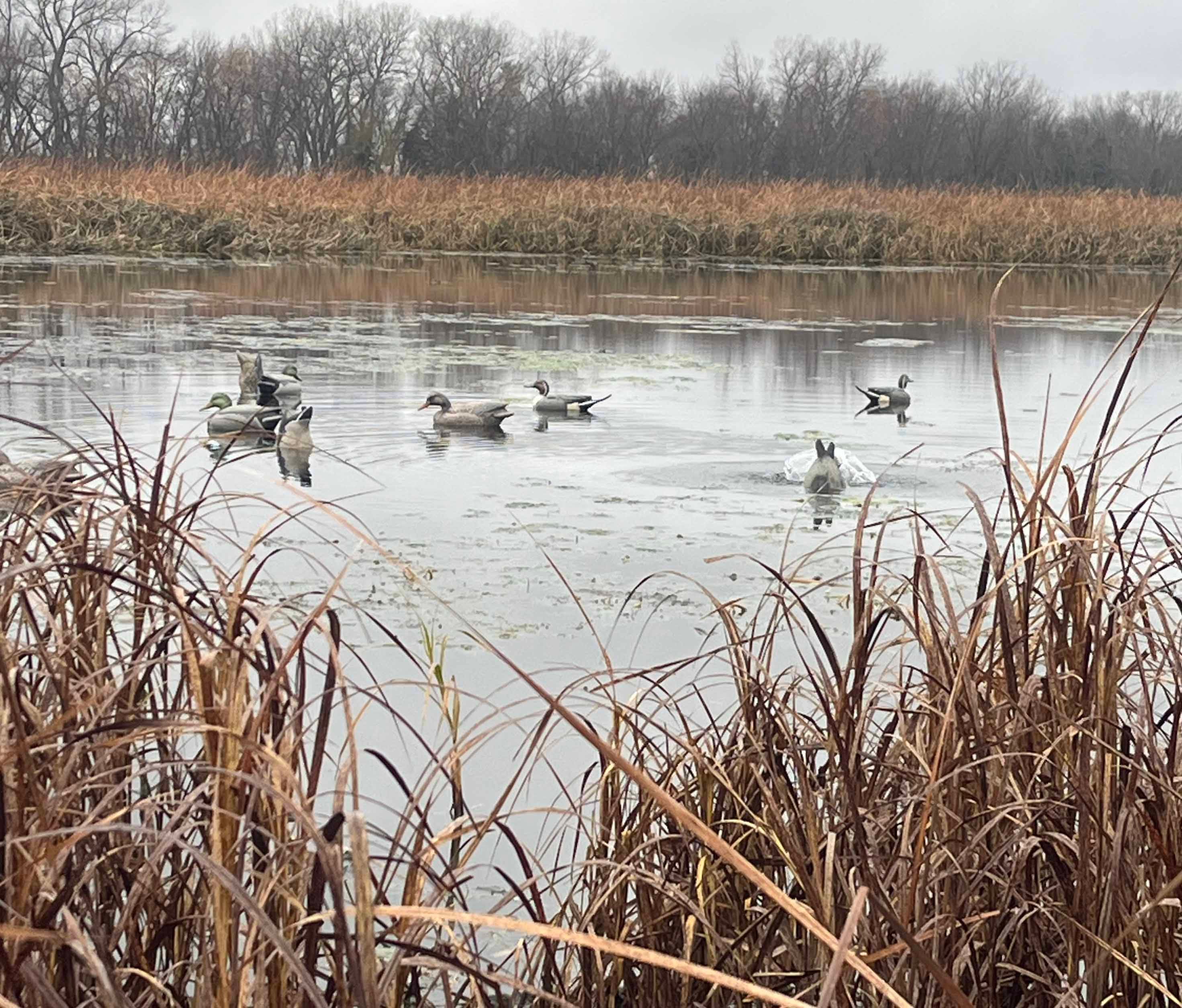
Duck decoys in early December (JT Colbert)
“Too soft to walk and too hard to swim” – Tab Benoit (Muddy Bottom Blues)
When settlers of European origin began moving into Iowa in the early 1800s there were about four to six million acres of wetlands in the state – about 11% of the total area comprising Iowa. Wetlands were especially frequent in the north central one sixth of Iowa – the so-called “Des Moines Lobe”. This part of the state was glaciated during the most recent (“Wisconsin”) glaciation of Iowa. When the glacier melted it left behind a landscape that was a maze of small ponds and wetlands. One of the few places that you can still see something of what this part of Iowa was like pre-European settlement is the Union Hills Wildlife Management Area near Clear Lake, Iowa.
As you can imagine a settler desiring to start a farm in north central Iowa was faced with a couple of choices. They might have thought “that looks impossible to farm, plus it helps minimize river flooding and produces huge quantities of waterfowl. We should just leave it alone”. Alternatively, they may have thought “you know – if we dug drainage ditches we COULD farm this”. You can guess which choice was made. In the north central part of Iowa 99% of the wetlands were drained using a combination of drainage ditches and field drainage tiles. Iowa currently has about 2,100 miles of drainage ditches and “hundreds of thousands of miles” of field drainage tiles, with more being installed every year. Statewide, 90-95% of Iowa’s wetlands have been drained. There has been a lot of corn and soybeans produced in what used to be wetlands.
Currently, there is a great deal of concern about “water quality” in Iowa. Most of this concern focuses on pollutants, such as “nitrates” and “phosphates” in the water that can make drinking water production expensive. These pollutants also lead to the presence of the “dead zone” at the mouth of the Mississippi River, as well as causing algal blooms in local ponds and lakes. The possibility of pathogenic organisms in the water, as indicated by high Escherichia coli (“E. coli”) levels, is also an issue and results in closed swimming beaches every summer in Iowa. These concerns, and others such as the presence of insecticides, herbicides, etc. in the water, are certainly valid. But quantity has a “quality” all its own.
Human agricultural activities have converted Iowa from “a sponge to a storm sewer”. Heavy rain and melting snow are not uncommon in Iowa. Water that would have stayed on the landscape, slowly entering streams or evaporating into the atmosphere, is instead quickly transported out of the field. When water is removed from the agricultural landscape, using drainage ditches and field drainage tiles, it doesn’t just “disappear”. It quickly moves to a creek, stream, or river. This rapid increase in the quantity of water results in two things that are of concern to humans: floods and stream bank erosion. The impact of floods is obvious and can be both extensive and expensive. The impact of stream bank erosion is quieter and more insidious. Large quantities of the best soil in the world slipping into the murky brown water and beginning a journey to the Gulf of Mexico. I’ve seen it happen. There’s just a soft, muddy, splash and that portion of the bank is now part of the sediment-laden river. The effect of quickly adding large quantities of water to our rivers and streams can easily be seen at any time simply by observing the steep, deeply incised, banks bordering them.
The rapid transport of water by drainage ditches and field drainage tiles can also, somewhat paradoxically, lead to LOW water levels in rivers and streams. The reason is that wetlands, by holding and slowly releasing water over time, can help maintain water levels in rivers and streams during dry periods. Dry periods tend to pose fewer problems for humans – no need to worry about your home or business being flooded. But a dry riverbed can pose huge problems for some species of aquatic animals. Fish tend to be mostly ok – they are mobile, and they can swim downstream to where there’s more water. But other, less mobile, animals can be in real trouble if the river runs dry. The easiest example of this to point to is freshwater mussels. Iowa had a native diversity of 55 mussel species. Because of low water events, as well as siltation, pollution, and introduced mussel species, today it’s possible to find only about 40 species in Iowa, many of which are rare and listed as threatened or endangered. Wetland drainage has a cascade of effects in addition to producing bushels of corn and beans.
In the late 1800s or early 1900s wetlands were generally thought of as “waste areas” that needed to be “improved”. We’ve since come to realize that wetlands have far more value than that. There are on-going attempts to restore or reconstruct wetlands throughout the state. A USDA effort the “Conservation Reserve Enhancement Program” (CREP) seeks to construct wetlands for water quality improvement and soil erosion control, primarily in north central Iowa.
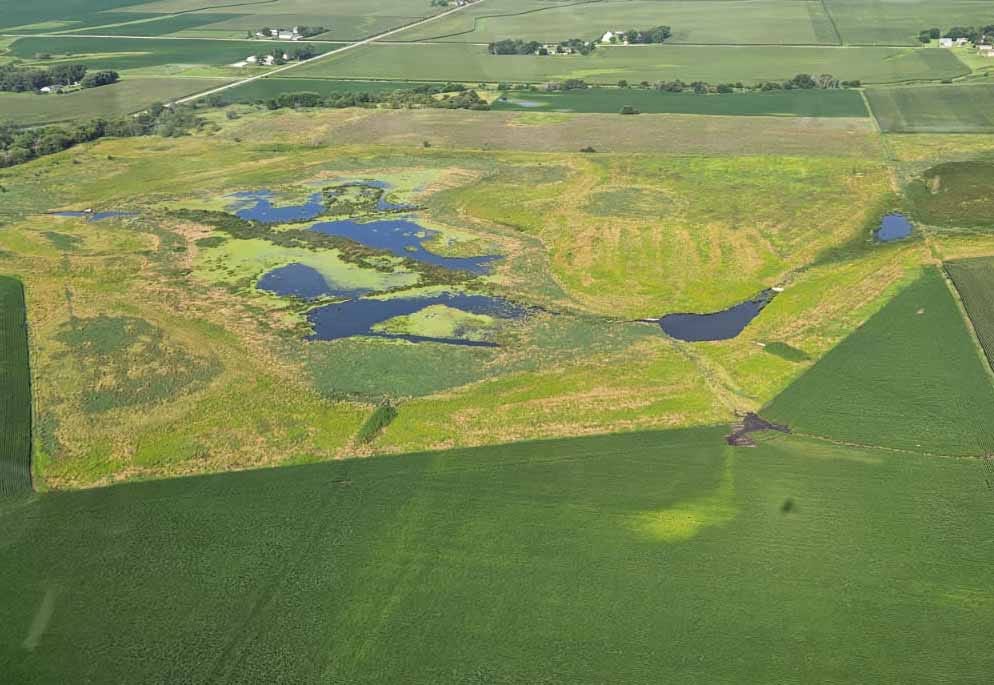
An aerial view of a north central Iowa CREP site in a sea of row crop fields. (Photo credit: Mark Lund, used with permission)
In addition, waterfowl hunting groups such as Ducks Unlimited and Delta Waterfowl help raise funds to produce and protect wetlands, including wetlands where hunting is not allowed.
All of that is “good news”. Good news for water quality (and quantity). Good news for soil erosion control. Good news for wildlife (and not only ducks…) habitat. But here’s the bad news. Iowa CREP is designed to enroll about 9,000 acres. That sounds like a lot until you remember that Iowa once had 4 to 6 million acres of wetland. Nine thousand acres is about 0.2% of the wetlands we once had. That brings us all the way from 1% of our original wetlands in north central Iowa to 1.2% of our original wetlands in north central Iowa. CREP is great idea but to have a meaningful impact it would need to be scaled up by a LOT. Our current efforts to restore wetlands are a “poster child” for agribusiness that says “see – we’re doing something good”, but it’s a tiny band-aid slapped on a gaping wound. We can, and should, do much better. But doing so will require the political will to provide the needed resources. The people of the State of Iowa voted in a mechanism to provide those resources in 2010. Sixteen years later our representatives in the State Legislature have still failed to act.
If you’ve read this piece, or any other of my pieces, you’re probably asking some version of this question: “How did Jim get to be so weird?”. Now for the low, low price of $15.95 (plus tax and shipping), you can answer that compelling question. Click here. Proceeds (should any ever occur) donated to local environmental groups.
I hope Art Cullen gets this piece. He will be in good company. Very ice, Jim.
Some IDALS wetlands are attracting waterfowl and shorebirds, but as effectively as the former wetlands. The take-no-prisoners approach of suburban expansion and maximized crop yields has little room for wildlife and natural hydrology. It’s too bad; we need a different and older idea of beauty. Thanks for the reminder about our wetlands.