In Your Nature
Is hunting a sport?

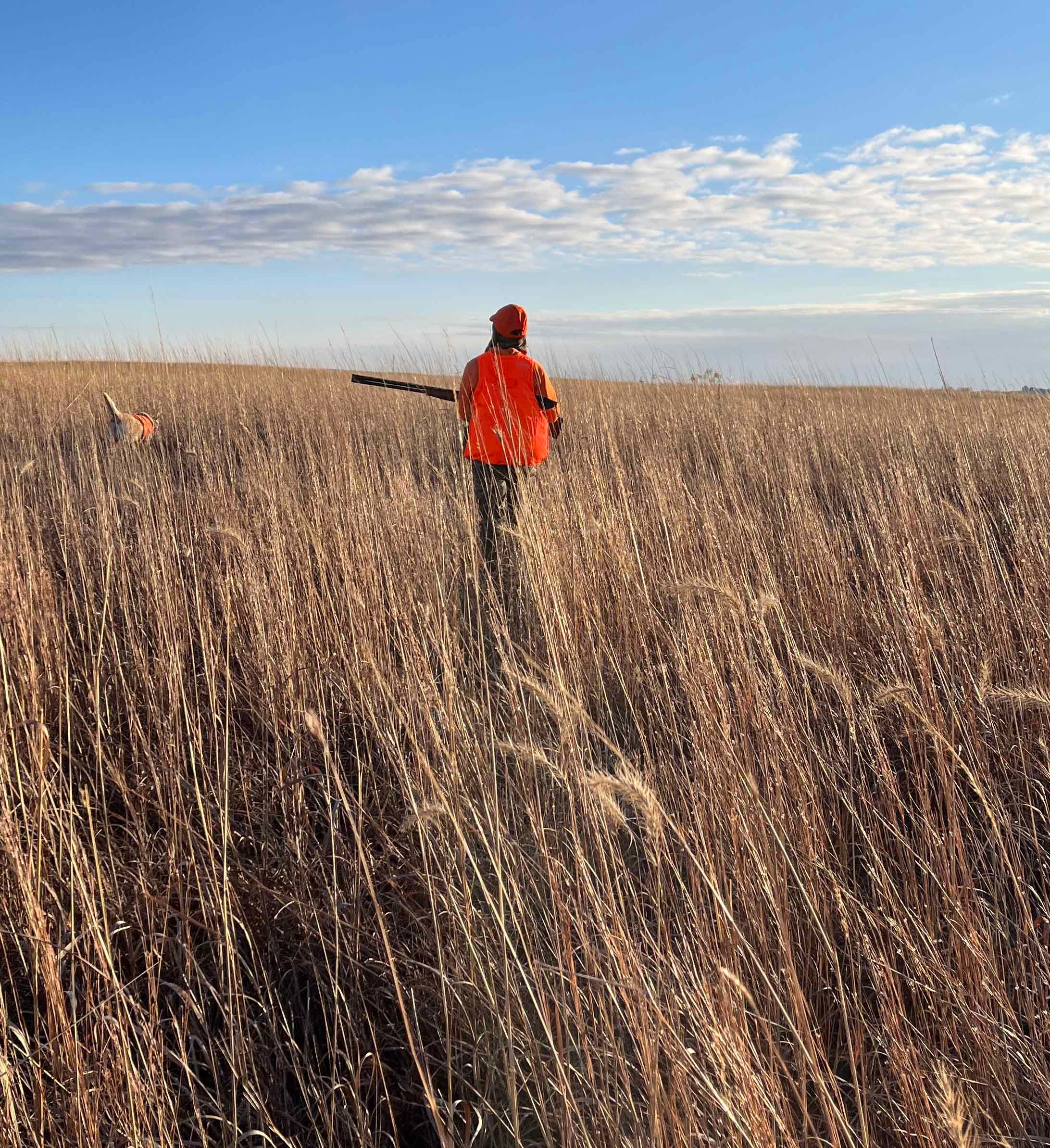
Pheasant Hunting (JT Colbert)
There are a lot of human activities that are clearly sports. You’ve got your pointy-ball with touchdowns (six points) and field goals (three points). There’s round ball with 1-pointers, 2-pointers, and 3-pointers. There’s multi-colored round ball with almost no points ever scored. Then you’ve got little round ball with runs instead of points. Even ice dancing has points, though no one seems to be quite sure where they come from. There are plenty of other sports that don’t involve balls too. Running. Jumping. Skiing. Wrestling. Horse racing. Ice hockey and many more. All of which involve competition and scorekeeping.
There are clearly many positive aspects to participating in sports. Being physically active is good for your health. Learning to work as a team is an important life skill. Abiding by rules and coming to understand that it’s better to play by the rules and lose than to cheat and win is important. Learning that hard work can lead to improved performance. Learning how to teach younger people to improve at difficult skills. Sports can even be an effective way to get “dates” with desirable partners. I participated in some youth sports myself though I don’t recall that resulting in any “dates”. I also did some time as a youth baseball coach and a youth softball coach when my children were young. There are two common themes in all these sports activities: competition and scorekeeping. Hunters are often referred to as “sportsmen” or “sportswomen”. So – is hunting a sport? It depends.
Some hunters do have a “sportsperson-like” approach to hunting. They compete with other hunters for who can bring home the largest number of species X during the season. They compete with other hunters for who can bring home the largest number of different species over the course of a season, or over the course of their hunting lifetime. They compare and compete about how much this animal or that animal weighed. Those who hunt antlered species (white-tailed deer, elk, etc.) often measure the antlers using a very precise system so they can compete with other hunters who have also successfully hunted the same antlered species. The system is complex, though possibly less complex than scoring ice dancing performances. Record lists are kept by state of animals with exceptionally large antlers. I imagine it looks something like the “leader board” at a golf (“little, really hard, round ball”) tournament except bigger numbers are better. I’m not aware of any hunting competitions that offer cash prizes, but being successful at bringing a “record” animal home can certainly result in promotional deals and “brand” recognition. In this context it seems to me that hunting could validly be thought of as a “sport”.
Fisher people, who for our purposes here will be thought of as “people who hunt fish”, have elevated competition to real time events. There are fishing tournaments at many locations around the country, including here in Iowa. The most common fish species targeted is largemouth bass, but there are tournaments focused on other species as well ranging from the “lowly” channel catfish in Iowa to prestigious marlin tournaments in the deep blue sea. There is competition amongst the participants and there is scorekeeping – the total weight of fish caught by each participant is carefully measured. Thankfully, such tournaments generally require that the fish be returned alive to the water. My understanding is that there can be substantial monetary prizes for winning such competitions. Tournament fishing is clearly a “sport”.
Many people find sports to be an enjoyable way to pass their precious time as a living human, either as a participant or as an observer. As a species, we value sports highly. It is estimated that the global sports industry has a value of over $2.3 TRILLION. At the professional level a tiny fraction of the human population meets their actual physical needs (food, shelter, water, medical care, etc.) because of their involvement in sports. Unless being entertained and talking about the “big game” with acquaintances is a “physical need”, I would argue that the observers meet none of their actual physical needs through watching sports. I hate to break it to Seattle Seahawks fans, Los Angeles Dodgers fans, or Denver Nuggets fans, but these are “made-up” games that don’t really matter in the same way that having enough to eat does.
Personally, I don’t approach hunting as a “sport”, I approach it as a way of life that has meaning irrespective of competition or scorekeeping. A way of life that has deep roots in the history of my species. I hunt as a way of partially meeting a basic human need (food) and as way of connecting with, and being an active participant in, the natural world. I hunt as way to learn in depth about some of the creatures I share this planet with. I hunt as a way of spending valuable time with family and friends. I hunt as a way of connecting with younger, less experienced, humans by helping them learn to be safe, ethical, and effective hunters. I hunt because spending time in the natural world, the real world, is interesting, challenging, and compelling in a way that a “touchdown” or “three-pointer” can’t be.
Some might posit that there is “competition” in hunting because hunters are competing with the animals they’re hunting. I would argue that is a fundamental misunderstanding of both hunting and competition. A crucial aspect of “competition” is that the competitors are playing by the same rules. That is not the case in hunting. The animal being hunted is using its evolutionary inheritance to stay alive in a challenging environment long enough to reproduce and pass on its genes to the next generation. Part of survival is being able to detect and avoid potential predators. The hunter is using their skills, tools, and their understandings of the behavior of another species to avoid being recognized as a potential predator and to, hopefully, bring home dinner. As hunter, I am competing only with myself. Can I learn more about the species I’m hunting to be more successful? Can I persevere through challenging weather while remaining safe and functional? Can I keep going when I’m tired? Persistence is, and always has been, essential because part of hunting is “luck” and time on task is critical. Success in hunting is exceeding what you thought were your limitations – even if you don’t bring home dinner that day.
I have no real objection to sports, if they don’t get in the way of young people spending time outdoors hunting, fishing, hiking, canoeing, bird watching, camping, learning the names of their local biodiversity, or any of the many other things that can be done in the natural world. People choosing to make hunting or fishing a “sport” is fine with me – as long as they are doing so legally, ethically, and safely. But as you can probably guess, I’m not a big sports fan. If it were up to me, every professional sports team would be required to make donations toward conservation, public land and water access, protecting endangered species, preserving biodiversity, human health research, eliminating poverty, and mitigating climate change in an amount equal to the total salaries of their coaches, staff, and players each and every year. These issues seem much more important to meeting physical human needs than does entertainment. I’m not holding my breath. In any case, I’m a “hunter”, not a “sportsman”.
If you’ve read this piece, or any other of my pieces, you’re probably asking some version of this question: “How did Jim get to be so weird?”. Now for the low, low price of $15.95 (plus tax and shipping), you can answer that compelling question. Click here. Proceeds (should any ever occur) donated to local environmental groups.
Jm, thank you for such a considered and articulate piece. I’m writing, of course, from the UK, where attitudes to hunting sit in a rather different cultural landscape, and where, speaking only for myself, I don’t support hunting and have never taken part in it. Even so, I found your reflections genuinely illuminating. What struck me most was the distinction you draw between hunting as “sport” and hunting as a way of living meaningfully in the natural world. Over here, the word sport in relation to hunting tends to conjure images of aristocratic tradition, red coats, and a long history of privilege rather than sustenance. That’s part of why many of us react strongly against it: the activity is often associated with spectacle rather than necessity, and with competition rather than connection. Your piece makes it clear that this is not the world you inhabit.
I may not share your enthusiasm for hunting, but I can respect the seriousness with which you approach it, the emphasis on food, on learning, on patience, on understanding another species well enough to move through its world without arrogance. There’s something in that mindset that resonates even with those of us who prefer to observe wildlife rather than pursue it. The idea of “competing only with yourself” feels closer to the quiet disciplines of walking, birdwatching, or even gardening than to anything resembling a scoreboard.
Your point about time outdoors also lands strongly from a UK perspective. We’re wrestling with the same anxieties about children spending less time in nature, and the same sense that the outdoors is becoming a backdrop rather than a lived environment. Even if our paths diverge on the question of hunting, I think many of us would agree wholeheartedly with your wish for young people to know their local biodiversity, to feel weather on their skin, and to develop a relationship with the more than human world that isn’t mediated by screens.
Where I suspect we might still differ is on the question of necessity. In Britain, hunting for food is far less common, and the ecosystems are smaller, more densely populated, and more tightly regulated. For many of us, the idea of killing an animal, even ethically and with purpose, feels unnecessary when other options are readily available. But, reading your account, I can at least understand how, in the context you describe, hunting can be woven into a meaningful, responsible, and ecologically aware life.
So, while I remain someone who doesn’t support hunting personally, I appreciate the clarity and sincerity of your perspective. You’ve articulated a relationship with nature that is thoughtful, grounded, and far removed from the trophy‑driven caricatures that often dominate the conversation and that, in itself, feels like a valuable contribution.
I believe the term "sport hunting" was coined during the late 19th century by Teddy Roosevelt and other prominent hunters to differentiate themselves from market hunters, and to establish regulations and promote conservation. Check out this from Boone-and-Crockett.
https://www.boone-crockett.org/sport-hunting-hunt-fair-chase#:~:text=The%20term%20%E2%80%9Csport%20hunting%2C%E2%80%9D,or%20her%20a%20sporting%20approach.