In Your Nature
Make it pay by using clay

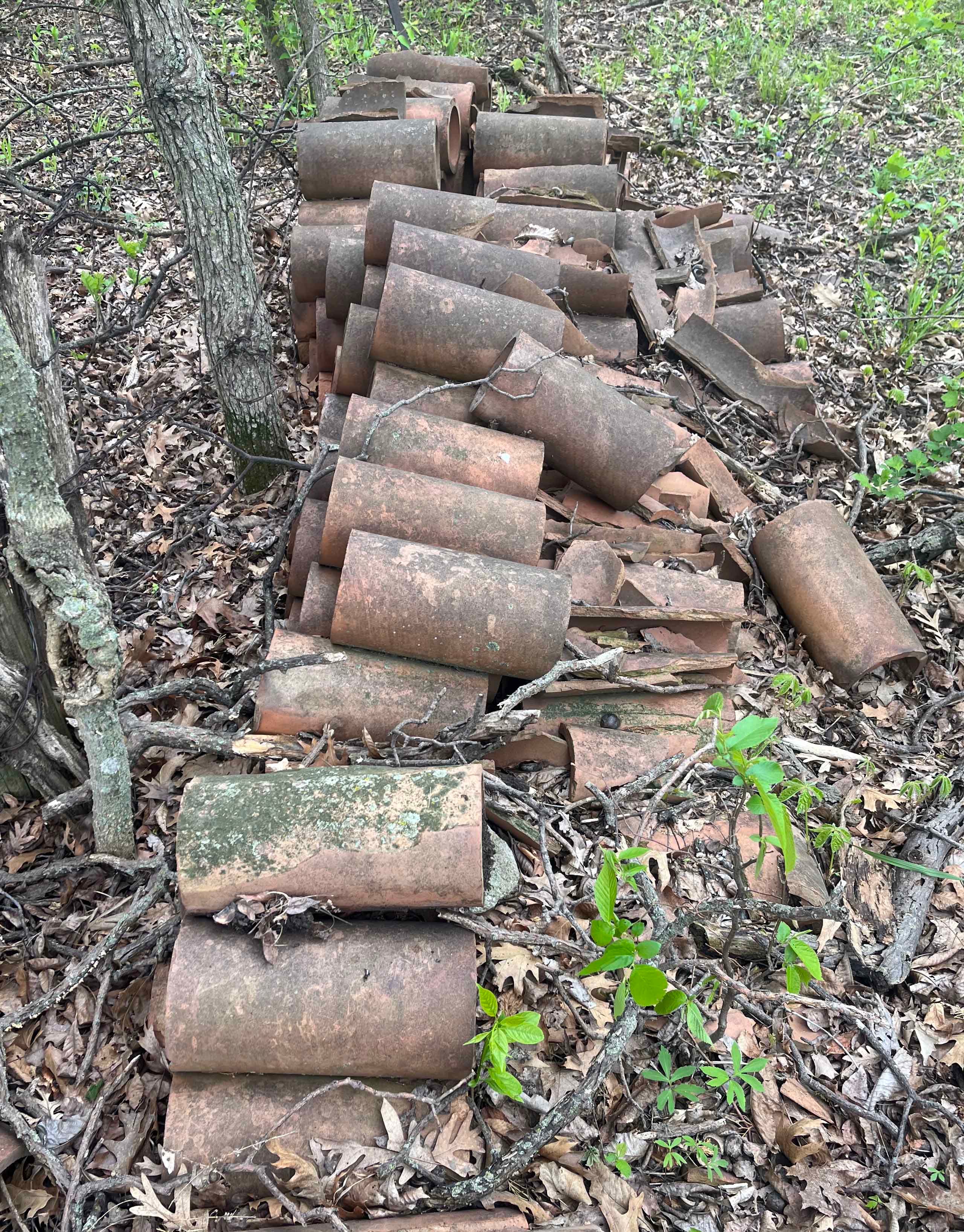
Unused clay tiles that never made it into the ground (JT Colbert)
Driving through central Iowa today one could be forgiven for thinking that this land had ever been anything other than corn and soybeans. About 24 million of Iowa’s 36 million acres are currently used to grow corn and soybeans. That’s about 2/3 of the entire state. Additional millions of acres are used as pasture or to grow crops like alfalfa. You don’t have to drive far in Iowa to see land in agriculture. Just don’t think of that land as “natural” – it is highly human modified and managed.
It would be easy to imagine that when settlers of European heritage started moving into Iowa in large numbers during the mid-1800s all they needed was one of John Deere’s new -fangled self-scouring steel plows and diverse native prairie would become crops that could provide a large family with a livelihood. In much of the state, especially in north-central and northwest Iowa, it was not that simple. Extensive networks of wetlands and “prairie potholes” made farming impossible in much of the state, with or without a John Deere plow. There was simply too much water and too much soggy soil. This is why those parts of the state were the last to be converted to agricultural use.
What was needed to allow agriculture was increased drainage from the highly biodiverse and productive (though not in human economic terms) wetland landscape. Part of the solution was to dig drainage ditches to move water more quickly to rivers and streams. This was a very laborious task with the technologies initially available – horses and people with shovels. Drainage ditches alone were effective in some parts of the state, but in north-central Iowa another approach was needed – the entire water table needed to be lowered to make the land “pay”. By the 1880s “drainage tiles” were beginning to be installed in the wetter regions of the state. Drainage tiles made the land more valuable (had the ducks been asked, they might have disagreed) by lowering the water table and allowing the land to be farmed. This sub-surface drainage was accomplished by the production and use of “clay tiles”. Clay could indeed make the land pay.
Clay tiles were produced in factories around the state including the Jefferson Cement Products Company in Greene County, Johnston Brothers Clay Works in Webster County, and the Rockford Brick and Tile Company in Floyd County. Production of clay tiles at the Rockford facility began in 1910 and didn’t end until the 1970s. The tiles could be produced in various diameters, but each piece of tile was twelve inches long. The idea was to place each piece of tile into a ditch and align them end-to-end. The narrow space between each adjacent piece of tile would allow water to enter the tile line. Once inside the tile line the course of least resistance for the water would be to flow from one piece of tile to the next and thence quickly into a drainage ditch or stream.
The “tough part” of course was digging the ditch in which to place the tiles. Much of the hard work of digging tile lines was done by recent immigrants including people from Sweden and Ireland. The work consisted of digging, with a shovel, a trench three to four feet deep in heavy, wet, soil and then lowering in the individual pieces of clay tile. The tile diggers were referred to as “Iron Men” due to the difficulty of the work.
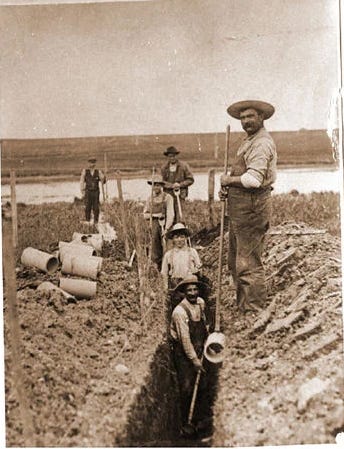
“Iron Men” at work circa 1900 (Source)
The work would have been almost inconceivably hard by today’s standards. Working outdoors in the prevailing weather. Living on site in tents or shacks. Eating locally sourced ducks, geese, turtles, frogs, and fish. Many, many, miles of tile lines were hand dug throughout north-central Iowa. It’s hard to know what is more impressive – the amount of backbreaking labor required, or the ecological devastation wrought by those efforts.
Starting in the 1970s, clay tile began to be replaced by perforated plastic pipe. Plastic pipe was used to replace failing clay tiles, as well as to add additional tile lines in a less labor-intensive and on-going effort to make the land more amenable to row crop agriculture. Though no precise estimate is available, Iowa currently has hundreds of thousands of miles of agricultural drainage tile. Just one county in Iowa (Greene County) has about 3,000 miles of public agricultural drainage tile, plus an unknown (but much larger) number of miles of private agricultural drainage tile. Iowa is more extensively tiled than any other state in the “corn belt”.
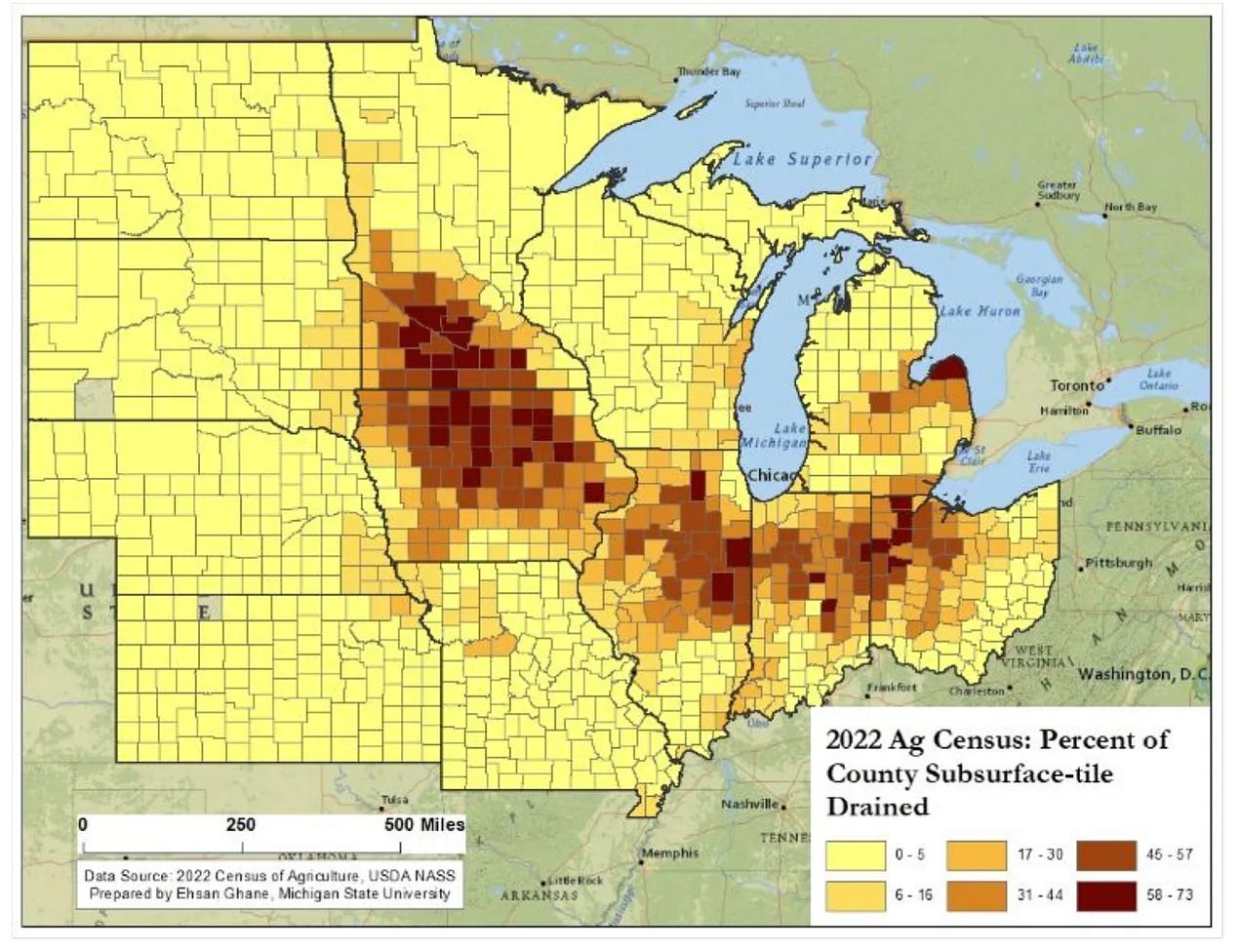
Density of agricultural drainage tile in the “corn belt” (Source)
There were, unsurprisingly, many impacts from all this tiling. First, of course, there was a tremendous decrease in the number of wetlands. Some people (not the “iron men”) got very wealthy. Huge amounts of corn and soybeans were produced. Innumerable chickens, hogs, turkeys, and cattle were fed. Currently, about 50% of Iowa’s corn crop is used to produce ethanol of dubious environmental value for fueling vehicles. Populations of ducks, and other wetland species crashed in Iowa. For example, cricket frogs are no longer present in much of northern Iowa. Water moved much more quickly from the landscape to rivers and streams resulting in extensive stream bank erosion.
One, rather unexpected, impact of tiling was to reveal some of Iowa’s ancient past. At the Rockford Brick and Tile Company site, Devonian Era shale was excavated and crushed to be made into clay tiles. The spoils from those excavations remain today and include a wealth of Devonian Era (~ 380 million years old) fossils. These fossils include brachiopods, corals, crinoids, and gastropods. One can visit the Rockford Fossil and Prairie Park and collect these fossils. In a sense this allows one to “snorkel” through an ancient shallow ocean here in Iowa. It’s also a good reminder that nothing lasts forever – even Iowa’s thousands of miles of agricultural drainage tiles. But we may want to ask ourselves – do we really want more tile? Perhaps less tile and more wetlands would be a better gift to the future. I’m confident that the ducks would approve.
PS: My thanks to Robert Leonard for suggesting that clay tiles might make an interesting story.
If you’ve read this piece, or any other of my pieces, you’re probably asking some version of this question: “How did Jim get to be so weird?”. Now for the low, low price of $15.95 (plus tax and shipping), you can answer that compelling question. Click here. Proceeds (should any ever occur) donated to local environmental groups.
Such an interesting and valuable post! Thanks for writing it. I’ve always found that there are often (always?) fascinating stories behind the most “mundane” things. I learned lots here—for example, the hard work and scrappy lives led by the people who trenched and placed the tiles. And now I’m wondering about the lives of the people who made the tiles, and how they made them. Every great story leads to another, another, another…Thanks so much!
Thank you for this historical background on tiling and tile making. Over the years we have found clay tiles that have made it to the surface. One time I used them to protect the celery I was planting - cool and moist environment.