In Your Nature
They're aware - are you?

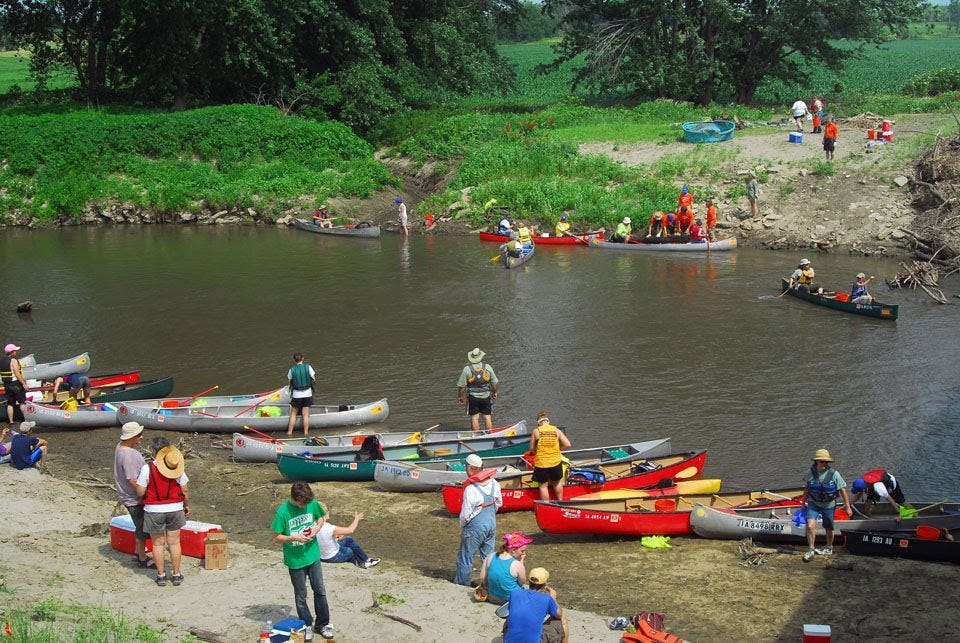
2007 Project AWARE Participants (Source)
On Monday 13 July 2026 I had the opportunity to help Project AWARE volunteers learn more about Iowa’s native biodiversity. But before I get to that I should provide some context and some background.
Project AWARE (“A Watershed Awareness River Expedition”) began in 2003 and was led by the Iowa Department of Natural Resources. The idea was a week-long canoe float and camping trip on one of Iowa’s many navigable rivers while learning about Iowa natural history and biodiversity - and picking up trash along the way. This effort has continued for 23 consecutive years. Currently, Project AWARE operates through a non-profit called N-Compass Inc., with the Iowa DNR and the State Hygenic Laboratory (at the University of Iowa) serving as major partners. Almost seven thousand volunteers have participated since 2003, and they have removed over 500 TONS of human-generated trash from our rivers and streams. It’s hard to know what’s more impressive – that 500 tons of trash were removed or that people were so careless as to put 500 tons of trash into our rivers in the first place. Sadly, Project AWARE has not run out of trash to pick up yet.
I wasn’t present for that first Project AWARE in 2003, but I volunteered in 2004, 2005, 2006, and 2007.
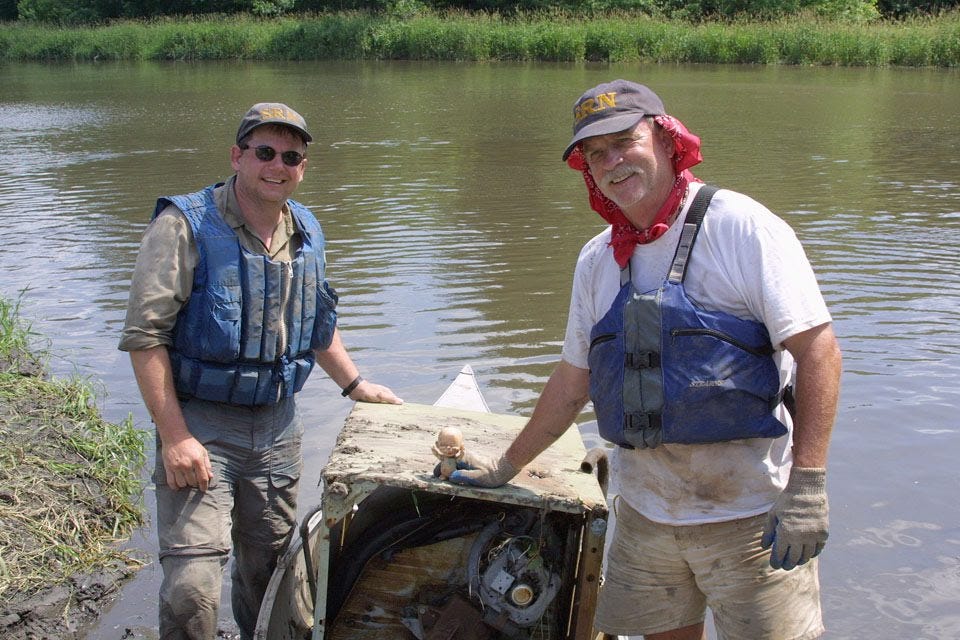
Yours truly (on the left) Project AWARE 2005, Little Sioux River (Source)
Other people have volunteered for AWARE many more times than I have. But when I stepped into the water to dig out some trash on my initial trip with Project AWARE it was not my first experience picking up wet, muddy, and heavy river trash. In the fall of 1998, I had started the Iowa State University Biology Program “Skunk River Navy” (SRN) effort. Similar in concept to Project AWARE it involved learning about local biodiversity and removing trash from the South Skunk River. There were, however, two major distinctions. First, the SRN was a one-day experience, not a week-long camping trip. Second, SRN participants were forbidden from being in the canoes – the canoes were strictly for trash. SRN Volunteers waded the (usually) shallow waters of the South Skunk (or Ioway Creek) and loaded the canoes with trash. A colleague and I led the SRN for twenty years, during which time about 2,400 volunteers removed 80 tons of trash over the course of fifty-one September Saturdays. The SRN has been in “dry dock” since the fall of 2017. It would be safe to say that I have more than a “passing familiarity” with the trash found in Iowa’s rivers and streams.
Trash is an obvious indication of the disrespect with which we have treated our rivers and streams in Iowa – and removing it from our rivers is a good thing. If only trash was the worst way in which we’ve disrespected these sparkling jewels, but it’s not. The worst ways we’ve disrespected our rivers and streams are two-fold. First, we’ve lowered water quality with various pollutants including nutrients, pesticides, potentially hazardous microorganisms, and sediments from eroding soil. Second, we’ve increased water quantity in our rivers and streams by draining wetlands, digging drainage ditches, installing agricultural field tiles, and building impervious surfaces such as a parking lots. Removal of trash from our rivers and streams does not, unfortunately, address the major issues impacting these important bodies of water. Making significant progress on these issues would require substantial and sustained funding. The good news is that the people of Iowa voted in a mechanism to do that sixteen years ago. The bad news is that the State Legislature has failed to put this mechanism into action for sixteen straight years.
I drove to Fayette County in northeast Iowa on Monday July 13 to provide an educational opportunity for AWARE volunteers who had spent all day in the heat paddling and hauling river trash out of the Turkey River. They would have easily been forgiven if none of them showed up to learn about Iowa’s lichens, including those lichen species that have been lost from Iowa since European settlement. These folks – ranging in age from middle school students to people way past retirement age – could have justifiably concluded that they were just way too tired to care about lichens. At least forty people showed up. They learned a few things, such as the fact that Iowa has about the same number of lichen species as it has bird species. We shared a few laughs. We talked about “lichen sex”. And – as tired as I’m sure they were - they came up with some remarkably good questions. It was inspiring. Almost as inspiring as the hard work they were volunteering to do on behalf of the rest of us.
Project AWARE volunteers are, indeed, “aware”. They are aware that our rivers and streams are natural treasures here in the intensely agricultural landscape of Iowa. They are aware that throwing trash into rivers with an “out of sight, out of mind” mentality is wildly disrespectful. They are aware, or are learning to be more aware, that, sadly, trash is merely the tip of the iceberg with respect to the issues facing our rivers and streams. The water may, at times, not be safe to be in contact with. We’ve lost many of our freshwater mussel species. We’re contributing to both local algal blooms and the Gulf of Mexico dead zone. We can do something about this. We can make it better. But it will take many people who are “aware” to convince our political leaders to take the steps needed to make this happen. My hat is off to all the volunteers, staff, organizers, and sponsors who have made AWARE possible these past twenty-three years. I look forward to a day when Project AWARE will not be necessary. That will happen when the vast majority of the people of Iowa and our political leaders are fully aware that our rivers and streams deserve to be carefully protected and treated with respect.
If you’ve read this piece, or any other of my pieces, you’re probably asking some version of this question: “How did Jim get to be so weird?”. Now for the low, low price of $15.95 (plus tax and shipping), you can answer that compelling question. Click here. Proceeds (should any ever occur) donated to local environmental groups.
Thank you for your years and efforts with AWARE and the SNR.
It’s too bad that Iowa’s public education system doesn’t incorporate local awareness into general tops of physics (fluid dynamics), the social problem of trash and pollution, geology (erosion and sedimentation), biology (ecosystem functions and processes), math, writing, and more. With a few notable exceptions based mainly on specific teachers and their interests.
And thanks for stating the problems of awareness bluntly. The intentional destruction of the common good has had bad results.
Such important work/project. I am tempted to come volunteer myself!