In Your Nature
Ice Eagles

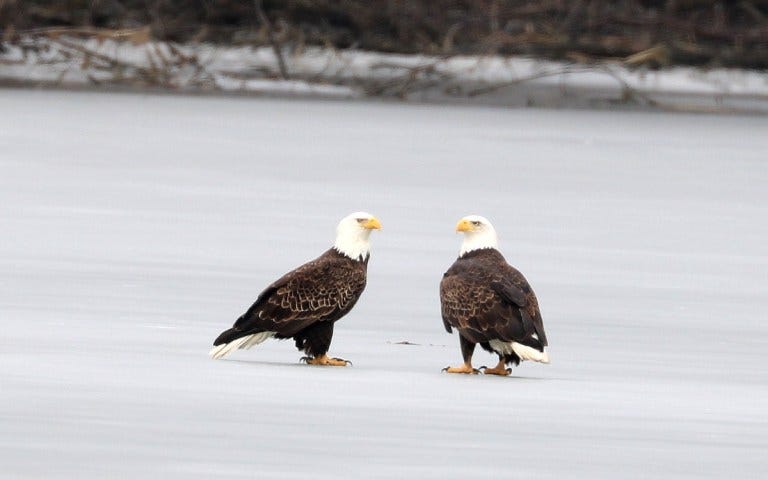
Bald Eagles on Ice (image source)
After nine years of construction, the Red Rock dam on the Des Moines River southeast of Des Moines was completed in 1969. The reservoir was expected to take several years to completely fill, but heavy rain filled it in just five days. I was in 8th grade in 1969, completely unaware of Red Rock Reservoir, and I had lived my entire life in Iowa without ever having seen a Bald Eagle, even though this magnificent species is native to Iowa.
Although I spent a lot of time as a young person in suitable Bald Eagle habitat along the Cedar River, it’s not surprising that I never saw one. By the early 1900s, Bald Eagles had been virtually extirpated from Iowa. Although an eagle might have occasionally overflown Iowa, there were no eagle nests in the state in 1969. The first documented reoccurrence of a Bald Eagle nest in Iowa was still eight years into the future. I didn’t see a Bald Eagle in the wild until 1983 along the Wisconsin River near Sauk City, Wisconsin.
Why had Bald Eagles been extirpated from Iowa? Not surprisingly, human misdeeds. Loss of suitable habitat, e.g., large trees for nests, likely played a role. Prior to 1940 (and most likely illegally thereafter) eagles were often shot due to actual, or perceived, or anticipated, attacks on livestock. As a species, we tend to have a deep-seated default setting of antipathy toward large predators. As it turns out the Bald Eagle diet is primarily fish – sometimes stolen from other species such as Ospreys – a behavior wonderfully called being a “kleptoparasite”. Waterfowl, small mammals, and snakes make up much of the rest of their diet. I’m sure it’s possible that the occasional chicken is taken home for dinner by an eagle. Bald Eagles are also carrion feeders. Eagles feeding on the carcass of a cow does not mean they killed it. The Bald and Golden Eagle Protection Act of 1940 made it illegal to kill these predatory birds.
Fortunately, for those wishing ill to Bald Eagles, in about 1940 another, more pervasive, threat to eagles took over the task of killing eagles. Dichlorodiphenyltrichloroethane (“DDT”) began to be used extensively to control insect populations. An initially unrecognized side effect of DDT was to cause eggshell thinning in birds such as Bald Eagles. Reproductive success decreased dramatically, and the already low Bald Eagle population crashed. The use of DDT in the United States was banned in 1972. Just five years later, in 1977, Iowa had its first Bald Eagle nest in many years. There are currently estimated to be over 800 Bald Eagle nests in Iowa, and nearly 6,000 Bald eagles are present in the state during mid-winter. An amazing recovery. We CAN have nice things if we find the political will to implement policies based on valid scientific data and understandings.
The human misdeed that is currently imperiling Bald Eagles in Iowa is the use of lead bullets in deer hunting. In the 1960s there weren’t many white-tailed deer in Iowa. Today there are around 400,000 deer in Iowa with about 100,000 deer killed by hunters each year. Some of these deer (around 20,000) are killed by arrows, but the majority are killed by bullets. If those bullets are made of lead, shattered pieces of the bullet end up in the viscera of the deer. The significance of this to eagles is that the viscera are typically left in the field (“field dressing”) and eagles are carrion feeders. Bald Eagles are big birds, but they only weigh about 10-15 lbs. That means consuming the small fragments of lead found in the pile of viscera left behind by a hunter can be dangerous, even fatal, to eagles. Effective non-toxic (copper) bullets are available for use in deer hunting. Hopefully, the political will to implement a ban on the use of lead bullets in deer hunting can be found. Lead shot was banned for use in waterfowl hunting 35 years ago. Some might argue that it’s “un-American” to be told what kind of bullets can be used for deer hunting. But what could be more American than protecting our national symbol?
Combining the area of Red Rock Lake, the Des Moines River, the associated wetlands, and the surrounding wooded ridges, Red Rock totals nearly 50,000 publicly accessible acres. That’s a “postage stamp” compared to a state such as Colorado that includes about 30 million acres of public land, which is nearly as large as the entire state of Iowa (about 36 million acres). But – for Iowa – the ~ 50,000 acres of Red Rock is a huge natural area. I spend a lot of time there hunting, fishing, foraging for mushrooms (sadly there are ZERO morels there), hiking, and exploring. The more difficult to get to parts almost feel like “wilderness”, especially when your outboard motor quits working. So, it’s unsurprising that I was there recently trying to invite a rabbit home for dinner. I was just as successful as Elmer Fudd. But I did see numerous large, dark-colored, birds perched in trees and soaring in circles in the sky. It was clear they weren’t turkey vultures because those don’t return to Iowa from their winter homes until mid-March or so. From a distance I guessed crows, but it quickly became evident that they were Bald Eagles, both immature (no bald head or white tail) and mature eagles. There were also groups of eagles sitting on the ice at many locations in the bay I was overlooking. I stopped counting at 50 eagles and decided to focus on awe rather than quantification. Quite a sight for a boy who grew up in a state totally devoid of eagles.
Not having observed eagles on ice previously, it took me a bit to think through why the eagles were sitting on the ice. Were their feet overheating? And then floating in a thin strip of water between the shore and the slowly melting ice, the answer became clear. Food, of course. Winter kill results in many dead fish, especially gizzard shad, being trapped under the ice. As the ice melts, the dead fish float to the surface and the eagles have an easy meal.
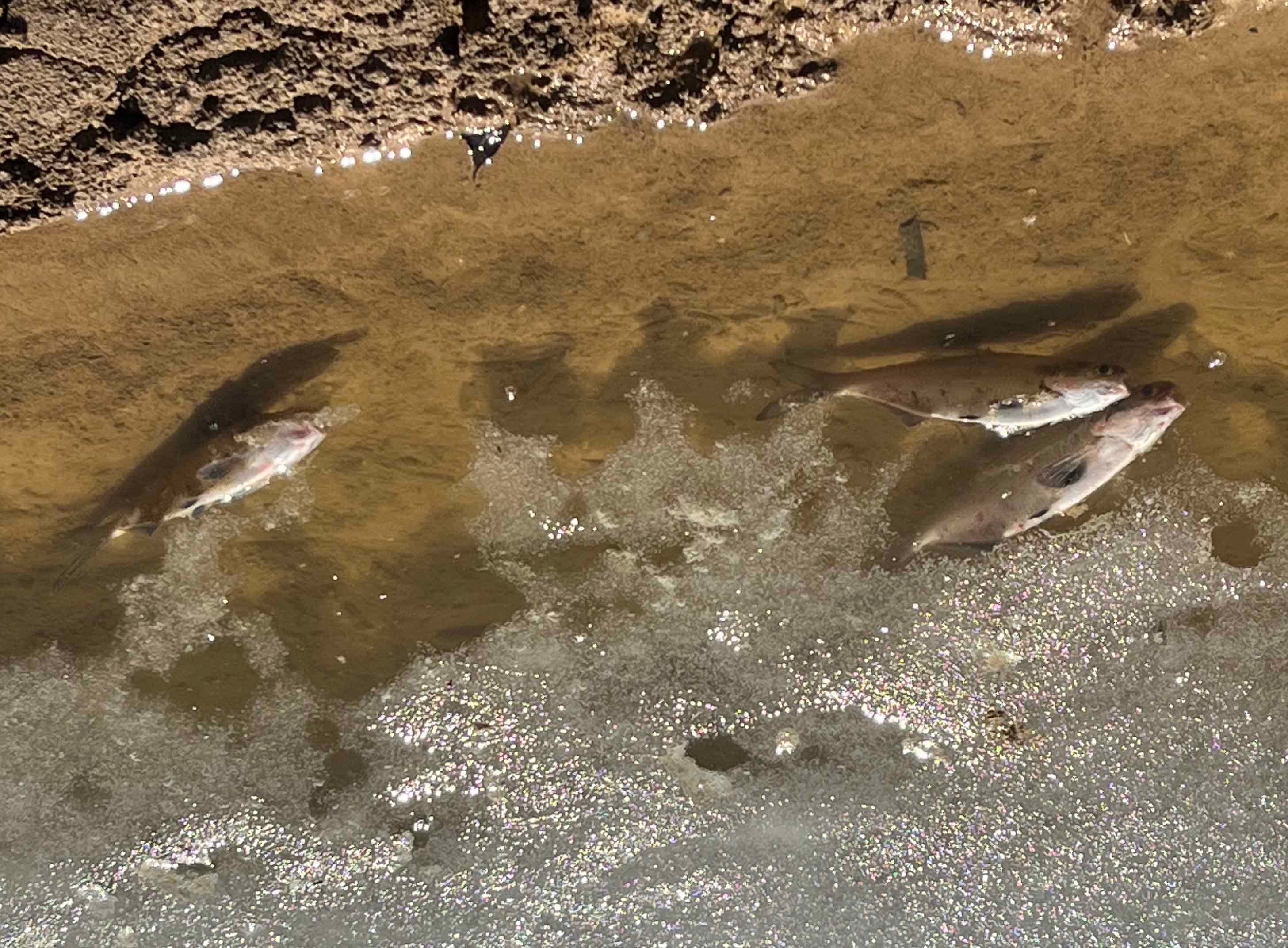
Dead gizzard shad on the edge of melting ice (JT Colbert)
The result? A large group of eagles perched in trees, soaring in the sky, and sitting on the ice waiting (patiently?) for dinner to be delivered by the late winter Sun melting the ice. They are, more or less, “ice fishing”.
What I find interesting is this: In 1969 when Red Rock Reservoir filled, there were no eagles in Iowa. Large numbers of Bald Eagles late winter ice fishing there is a relatively new thing, not something that has been going on for millennia. Bald Eagles live 20-30 years in the wild. Red Rock has been available for less than 60 years. So, the great grand eagles of the first Bald Eagles to take advantage of this food source could still be feeding there now. How did the eagles figure this out? Do they pass down this knowledge from parent to fledgling? Are the eagles feeding at Red Rock all individuals who were hatched there, or do eagles hatched elsewhere also show up at the Red Rock winter buffet? Does the information that Red Rock is a great late winter food source get passed on by word of beak? Some mysteries will probably never be solved. What’s not at all mysterious is whether it’s great to have large numbers of Bald Eagles present in Iowa again. It most certainly is.
If you’ve read this piece, or any other of my pieces, you’re probably asking some version of this question: “How did Jim get to be so weird?”. Now for the low, low price of $15.95 (plus tax and shipping), you can answer that compelling question. Click here. Proceeds (should any ever occur) donated to local environmental groups.
Jim, that 1983 siting in Sauk City made a more memorable impression on you than me, but seeing that memory was heartwarming of our days when we were trying to invite ruffed grouse home for dinner, and Sauk City was on the way to those invitations. Because of the era of DDT and no eagles, even today I still slow whatever I am doing to marvel at seeing these increasingly common birds, and recognizing how the actions of one species can have such a significant impact on another.
A lovely and thought‑provoking piece, Jim. From a UK perspective, your account of the Bald Eagle’s disappearance and recovery feels very familiar. Our own birds of prey, Red Kites, White‑tailed Eagles, Peregrines, Buzzards, and even Kestrels went through the same grim cycle of persecution, habitat loss, and pesticide‑driven decline and like Iowa’s eagles, their return has been one of the great quiet conservation successes of the last half‑century.
The beautiful Red Kite, once reduced to a handful of birds in mid‑Wales, now wheels over motorways and market towns; I saw one over the Erewash Valley not so long ago, very exciting. White‑tailed Eagles, extinct here for decades, are back on the coasts and beginning to push inland. The British Trust for Ornithology (BTO) track them. Even the everyday presence of Buzzards, almost absent in the 1970s, is a reminder of what happens when we stop poisoning the landscape and start listening to the science.
And then there’s the beautiful Hen Harrier, the bird that proves Britain can create a full‑blown conservation crisis without needing wolves, bears, or vast wilderness. All it takes is a grouse moor and a landowning class convinced that anything which may eat a grouse is committing lèse‑majesté. The males drift over the heather like apparitions and with the females, vanish from satellite tags with suspicious precision. If any species captures our national knack for turning a straightforward ecological issue into a moral pantomime, it’s the Hen Harrier, a wonderful bird persecuted not because it’s fragile, but because it insists on behaving exactly like a raptor.
The image you paint, Jim of dozens of eagles “ice‑fishing” on a reservoir that didn’t even exist two generations ago is wonderful. It’s a reminder that wildlife adapts quickly when we give it half a chance and that the landscapes we build can become part of the recovery rather than the decline.
A hopeful read, and a timely one.