In Your Nature
A little hope at Big Sand Mound

(JT Colbert)
A desert in Iowa? Shirley you jest (with many thanks to Naked Gun, the best comedy movie ever). But yes – Big Sand Mound Nature Preserve in eastern Iowa near the city of Muscatine is a little desert with cacti and everything. The 510-acre preserve on the “Big Sand Mound” is jointly owned by MidAmerican Energy and Bayer. The preserve is only open to the public once every three years, although researchers and school groups can access the area with permission at other times. The area is home to species that are rare in Iowa because extensive areas of sandy soil are quite unusual in the state. The sand was deposited by glacial meltwater when the most recent glaciation (~ 18,000 years ago) began to recede as the climate warmed. What was left behind has turned into an amazing place that provides both conservation and educational opportunities.
More than 400 plant species, including members of the genus Opuntia – “prickly pear cacti”, have been observed on the preserve. Some of these plant species are quite rare for Iowa. And it’s not just the plants that are unusual for Iowa. The sandy soil also provides excellent habitat for some rare reptiles as well. Both ornate box turtles and western hognose snakes are present on the preserve.
In 2012 one of my graduate students (Amy Podaril) and I were invited to survey the lichens of Big Sand Mound. This was only the second attempt to assess the lichen diversity of this unusual site – the first was in 1978. There were, of course, numerous common Iowa lichen species observed. All together about 40 species of lichens were recorded on site and the specimens are present in herbarium collections (for example, The Ada Hayden Herbarium) to allow future study. The results of the lichen research at Big Sand Mound Nature Preserve (and other sites in southeast Iowa) were published in 2015. What was unusual was the frequent presence of several species in the genus Cladonia on the Big Sand Mound site. Lichen species in the genus Cladonia are certainly found in Iowa, but they are much less common and diverse than they are in boreal forest and tundra habitats. One of the species we collected was Cladonia subulata (“antlered powderhorn lichen”).
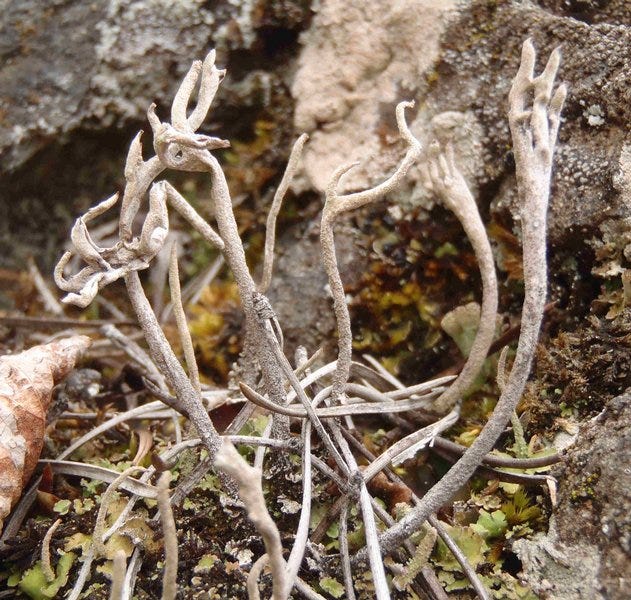
Cladonia subulata (Source)
When we checked all the previous records, it turned out that Big Sand Mound Nature Preserve is the ONLY place in the State of Iowa where this lichen has ever been reported. Revealing, once again, just how unusual and special this place is.
Since 2012 I have participated in three Big Sand Mound Nature Preserve Field Days. As you might expect, my role is to lead groups in learning about lichens on the preserve. Sadly, the parts of the preserve where Cladonia subulata is found are a long way from the visitor center. Too long of a walk on a hot summer day with a mixed-age group of people and a short timeline. But that doesn’t matter – even common lichens are “terra incognito” for the vast majority of the human population. So, I take each group of a dozen or so people into the shade only a short distance from the assembly point. We look for lichens, and we find them – in part because lichens are nearly everywhere, they’re just very easy to overlook. Once you learn to see lichens, you can’t NOT see them. We talk about their habitats, the fact that they are not plants, how to identify them, how they make their living (“fungi that farm algae”), and how they reproduce.
At the 2026 field day over 200 people, ranging in age from school children to those long past retirement, showed up on a warm June Saturday to learn about the geology, history, flora, fauna, and yes even the lichens of Big Sand Mound. And this is where the “hope” comes in. It was inspiring to see so many people gathered just to learn about Iowa’s natural world without the benefit of earning any “credentials” and no “tests” - except for the rest of their lives. Nature in Iowa, and around the world, is “under assault” due to the activities of humans. We risk catastrophic loss of biological diversity. But here’s the thing – it is impossible for people to care about losing things that they don’t know exist. Events like the Big Sand Mound Nature Preserve Field Day help more people care about the natural world because they know more. The more people who care, the greater the hope that we, as a species, will do a better job of protecting the natural world. Participants in the field day walked away knowing more about the local natural world and its amazing biodiversity. Hopefully, that knowledge, and the “caring” it allows, will translate into positive action to help protect the natural world. Personally, I felt honored to be a small part of introducing more people to the wonders of biodiversity. I hope that in three years I’ll get to do it again.
If you’ve read this piece, or any other of my pieces, you’re probably asking some version of this question: “How did Jim get to be so weird?”. Now for the low, low price of $15.95 (plus tax and shipping), you can answer that compelling question. Click here. Proceeds (should any ever occur) donated to local environmental groups.
Your lichen work at the Big Sand Mound sounds like great fun and of interest to many, once they learn what they are and their numerous forms.
I find a number of Cladonia around here and as you know well, this area has many. However I have never seen one as large as the one you show that really does look like antlers.
Good work.
Never knew this existed until now, Jim. Seems like some of the rarest and interesting things are literally just down the road. Hope you and Robert share more information about this unlikely treasure.